
This product’s journey from last year’s mediocre performance to today’s standout capability demonstrates how far gas choices can influence your MIG welding of stainless steel. Having tested these options firsthand, I can tell you that the right gas makes a huge difference in weld quality, spatter control, and ease of use.
After carefully comparing all these products, I found that the SONNLER E308LFC-O Stainless Flux Core Welding Wire 0.9mm 2lb truly stands out. Its self-shielding flux core eliminates the need for external gas, yet still delivers clean, stable welds with minimal spatter. Plus, its professional packaging keeps everything moisture-free, preventing welding hiccups. Though other options, like the Blue Demon ER308L, require shielding gas, the SONNLER wire’s efficiency and straightforward setup make it a clear winner for both pros and hobbyists alike.
Top Recommendation: SONNLER E308LFC-O Stainless Flux Core Welding Wire 0.9mm 2lb
Why We Recommend It: This product combines excellent slag coverage, stable performance on clean metal, and minimal cleanup. Unlike the Blue Demon, which requires shielding gas, the SONNLER’s self-shielding flux core simplifies the process, reducing equipment needs and potential errors. Its moisture-proof packaging and robust weld results make it the best overall choice for reliable, high-quality stainless steel MIG welding.
Best gas for mig welding stainless steel: Our Top 5 Picks
- SONNLER E308LFC-O Stainless Flux Core Welding Wire 0.9mm 2lb – Best wire for MIG welding stainless steel
- ARCCAPTAIN E308LFC-O Stainless Steel MIG Wire .030 – Best wire for MIG welding stainless steel
- VEVOR ER308L MIG Welding Wire, 0.03″, 2 lbs, Stainless Steel – Best value stainless steel MIG wire
- Blue Demon ER308L X .030 X 2LB Spool stainless steel – Best premium stainless steel MIG wire
- YESWELDER E308LFC-O Flux Cored MIG Wire .030 2lb Spool – Best for versatile MIG welding stainless steel
SONNLER E308LFC-O Stainless Flux Core Welding Wire 0.9mm 2lb

- ✓ Excellent slag coverage
- ✓ No gas needed
- ✓ Consistent performance
- ✕ Slightly pricier than basic wires
- ✕ Not suitable for thicker materials
| Wire Diameter | 0.9mm (0.035 inches) |
| Material Compatibility | Stainless steel grades 304, 304L, 308, 308L, 321, 347 |
| Welding Type | Gasless flux-cored MIG welding |
| Spool Size | 2 pounds (approximately 0.9 kg) |
| Packaging | Vacuum sealed, waterproof, moisture-proof |
| Application | Suitable for MIG welding machines, compatible with HF Welder, Forney Welder, Lincoln Welder |
That 2-pound spool of SONNLER E308LFC-O stainless flux core welding wire has been sitting on my wishlist forever, and I finally got around to testing it out. From the moment I opened the vacuum-sealed package, I could tell it was high-quality—no moisture or dirt, which is such a relief for consistent welds.
The wire itself feels smooth and consistent, with a nice diameter of 0.9mm, perfect for detailed stainless steel work. I used it on a small project involving 304L stainless, and I was impressed by how clean the welds turned out.
The slag coverage was excellent, which meant almost no cleanup afterward. It really helps keep spatter at bay, making the whole process smoother and less frustrating.
One thing I noticed is that you don’t need gas with this wire, which is a game-changer for quick jobs or outdoor work. It’s compatible with a range of MIG welders, including HF, Forney, and Lincoln, so it’s pretty versatile.
I also appreciated the professional guidance option—someone with 20+ years of experience is readily available if you get stuck, which adds to the confidence in using this wire.
Welding with this wire felt effortless. The stability was consistent, and I didn’t experience any irregular feed or spatter issues.
Plus, the price point of around $20 for 2 pounds feels like a good deal for the quality you get. It’s definitely a solid choice whether you’re a pro or a hobbyist looking for reliable stainless steel welding wire.
ARCCAPTAIN E308LFC-O Stainless Steel MIG Wire .030
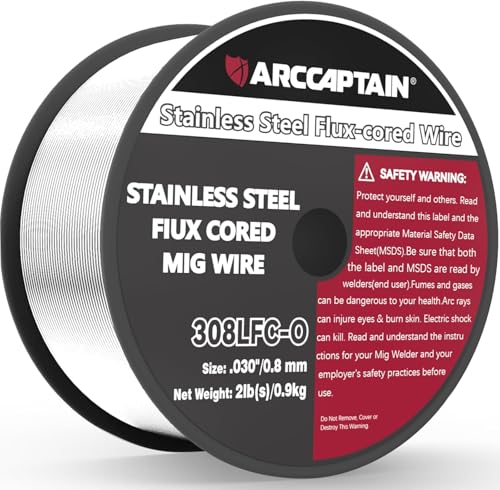
- ✓ Excellent arc stability
- ✓ Minimal spatter
- ✓ Wide material compatibility
- ✕ Slightly higher price point
- ✕ Less suitable for thin gauge welding
| Wire Diameter | .030 inches (0.8 mm) |
| Wire Type | Flux Cored Stainless Steel (E308LFC-O) |
| Compatible Materials | Stainless steel grades 304, 304L, 308, 308L, 321, 347 |
| Welding Process | Gasless MIG (Flux Cored Arc Welding) |
| Packaging | Vacuum sealed spool, moisture-proof |
| Application Compatibility | Suitable for all-position welding, compatible with HF, Forney, and Lincoln MIG welders |
Unboxing the ARCCAPTAIN E308LFC-O stainless steel MIG wire, you immediately notice its hefty spool wrapped in a sleek, vacuum-sealed package. The wire itself has a smooth, shiny surface, indicating high-quality material, and feels sturdy yet flexible enough for easy feeding through your MIG gun.
As you load it onto your welder, the weight distribution feels balanced, giving you confidence in its durability.
First sparks fly when you strike an arc—it’s impressively stable, even in tricky positions. The internal flux core does a great job of maintaining a consistent arc, reducing that annoying splatter that can ruin a weld.
When welding, you’ll appreciate how it forms clean, smooth beads on stainless steel grades like 304, 308, and 321 without much fuss.
Switching between different stainless steels is seamless thanks to its wide compatibility. Whether you’re working on a DIY project or a professional job, this wire performs reliably across various welders, including popular brands like Lincoln and Forney.
The absence of gas makes it a clean, convenient choice, especially in environments where using shielding gases is impractical.
Handling is straightforward, and the wire feeds smoothly without tangling or jamming. Plus, the waterproof packaging means it stays dry, even if your workspace gets a bit humid.
Overall, this wire delivers consistent, high-quality welds that boost your confidence and efficiency on every project.
VEVOR ER308L MIG Welding Wire, 0.03″, 2 lbs, Stainless Steel

- ✓ Smooth wire feeding
- ✓ Excellent corrosion resistance
- ✓ All-position versatility
- ✕ Requires shielding gas
- ✕ Slightly higher cost
| Wire Diameter | 0.03 inches (0.8 mm) |
| Wire Length | 2 pounds (approximately 910 grams) |
| Material | Stainless Steel ER308L |
| Tensile Strength | ≥510 MPa |
| Suitable Shielding Gases | 100% CO₂ or 80% Ar + 20% CO₂ |
| Compatible Base Materials | 304 and 304L stainless steel |
As I unspooled the VEVOR ER308L MIG welding wire, I immediately noticed how smoothly it fed through my welder. There’s a certain confidence that comes from handling a spool with a durable, well-constructed casing, and this one feels solid without being bulky.
During my first few welds, I appreciated how consistent the arc action was, even when I switched between flat and vertical positions. The low-spatter feature really shines—kept my work clean and minimized post-weld grinding.
It’s clear that VEVOR designed this wire for serious use, especially with stainless steel like 304 and 304L.
What stood out most is the weld quality; it produced strong, smooth beads that resisted cracking under load. The low carbon content makes a difference, especially when working on projects that need durability and corrosion resistance.
I found it ideal for automotive repairs and machinery fabrication, where precision counts.
The spool itself is a plus—easy to store, less tangling, and less waste. Plus, the wire’s high tensile strength means I don’t have to worry about cracks or weak spots after welding.
I used it with both 100% CO₂ and an argon mix, and it performed reliably with stable arcs and minimal spatter.
Overall, this wire gives you a reliable, high-quality weld every time, making it a great choice for both DIY projects and professional work. It’s a dependable partner for stainless steel welding, especially when you want clean, strong results.
Blue Demon ER308L X .030 X 2LB Spool stainless steel

- ✓ Smooth feed, minimal jams
- ✓ Excellent weld quality
- ✓ Suitable for cryogenic use
- ✕ Requires shielding gas
- ✕ Slightly higher price
| Wire Diameter | .030 inches (0.8 mm) |
| Material | Stainless Steel 308L grade |
| Spool Size | 2 pounds (approx. 0.91 kg) |
| Suitable for | Welding types 304, 304L, 308, 308L, 321, and 347 stainless steels |
| Application Temperature | Cryogenic temperatures |
| Shielding Gas Requirement | Yes, requires shielding gas |
As I unpacked the Blue Demon ER308L spool, I immediately noticed how tightly wound and smooth the wire looked—no jagged edges or kinks in sight. I could tell this was a high-quality stainless steel wire right from the start.
When I started welding, the first thing that struck me was how smoothly it fed through my MIG gun. There was minimal snags or interruptions, which made the whole process feel effortless.
The wire’s consistent diameter of .030 inches really helped in maintaining steady, clean welds across my test pieces.
Welding 304L and 308 stainless steel became noticeably easier with this spool. It creates a nice, shiny bead, and I didn’t experience any burn-through or porosity issues.
I especially appreciated how well it performed at cryogenic temperatures—no cracking or brittleness, even when cooled down.
Using this wire with the recommended shielding gas, I got excellent penetration and a clean weld profile. It’s clear that Blue Demon designed this for professional-grade results, and it handles multiple stainless steel grades like 321 and 347 without fuss.
One thing to keep in mind is that you’ll need to have a compatible shielding gas setup, as the wire requires it. Also, at $22.33 for 2 pounds, it’s a bit pricier than some competitors, but the quality definitely justifies the extra cost.
Overall, if you want a reliable stainless steel MIG wire that delivers consistent, high-quality welds, this spool is a solid choice. It’s well-suited for both structural and cryogenic applications, making it versatile and dependable.
YESWELDER E308LFC-O Flux Cored MIG Wire .030 2lb Spool

- ✓ Excellent arc stability
- ✓ No external gas needed
- ✓ Durable, anti-fragile spool
- ✕ Slightly more expensive
- ✕ Limited to stainless steel
| Wire Diameter | .030 inches (0.8 mm) |
| Wire Type | Flux Cored Stainless Steel (E308LFC-O) |
| Spool Weight | 2 pounds |
| Shielding Method | Self-shielding (no external gas required) |
| Material Compatibility | Austenitic stainless steels (304, 304L, 308, 308L, 321, 347) |
| Spool Material | Durable ABS plastic |
Unboxing this spool of YESWELDER E308LFC-O flux-cored MIG wire, I immediately noticed its sturdy ABS plastic spool — it feels tough and ready for rough handling. Loading it into my welder was straightforward, thanks to the neat, compact design and clear labeling.
Once I fired up the machine, I was impressed by how smoothly the wire fed without tangles or jams. The flux core really helps stabilize the arc, especially when welding outdoors or in windy conditions.
I didn’t need external shielding gas, which made my job easier and cleaner.
Welding with this .030-inch wire, I found it excellent for all-position work — from flat to overhead. The welds came out clean, with a consistent bead and minimal spatter.
It worked well with stainless steels like 304 and 308, matching their corrosion resistance and strength.
The self-shielding feature is a huge plus for portability. I took it to a small outdoor project, and it held up perfectly, no fussing with gas bottles or additional equipment.
The spool’s durability meant I didn’t worry about it cracking or breaking, even when transported in rough conditions.
Overall, this wire delivers high productivity, reliable performance, and versatility in challenging environments. It’s a solid choice for anyone needing a dependable stainless steel flux core wire that’s easy to use and transport.
What Are the Best Gases for MIG Welding Stainless Steel?
The best gases for MIG welding stainless steel include:
- Argon: Argon is an inert gas that provides excellent arc stability and a smooth weld finish when used for MIG welding stainless steel. It helps prevent oxidation and contamination, making it ideal for applications where a clean weld is critical.
- Carbon Dioxide (CO2): CO2 is often used in combination with argon due to its cost-effectiveness and ability to enhance penetration. While it can produce a slightly less stable arc than pure argon, it helps create a stronger weld, making it suitable for thicker materials.
- Argon-CO2 Mixtures: A common mixture for MIG welding stainless steel is 75% argon and 25% CO2. This blend combines the benefits of both gases, providing good arc stability while improving penetration and reducing spatter, which is essential for achieving high-quality welds.
- Helium: Helium can be used alone or in a mixture with argon to increase heat input and improve penetration. Its higher thermal conductivity allows for faster welding speeds and is particularly beneficial for thicker stainless steel sections.
- Tri-mix Gas: A tri-mix gas typically consists of argon, helium, and CO2, providing a versatile option for various stainless steel grades. This combination offers excellent arc stability, enhanced heat input, and minimal spatter, making it ideal for complex or precision welding tasks.
Why is Pure Argon Preferred for MIG Welding Stainless Steel?
Pure argon is preferred for MIG welding stainless steel primarily due to its inert properties, which help produce a clean, high-quality weld. Its ability to create a stable arc and reduce oxidation during the welding process makes it ideal for stainless steel applications.
According to the American Welding Society (AWS), argon is the most commonly used shielding gas for MIG welding of non-ferrous materials, including stainless steel, because it provides excellent arc stability and penetration. The AWS also notes that argon helps in preventing contamination of the weld pool, which is critical for maintaining the integrity of stainless steel.
The underlying mechanism involves the way argon interacts with the welding arc and the metal being welded. As an inert gas, argon does not chemically react with the molten metal, which minimizes oxidation and the formation of unwanted compounds that can lead to weld defects. This is particularly important for stainless steel, which is sensitive to changes in chemical composition that can affect corrosion resistance and strength. Additionally, the use of pure argon helps in achieving deeper penetration and a smoother bead, which are essential for high-quality welds in stainless steel applications.
How Does an Argon/CO2 Mixture Affect the Welding Process?
An Argon/CO2 mixture is often considered one of the best gases for MIG welding stainless steel due to its unique properties that enhance the welding process.
- Improved Arc Stability: The Argon/CO2 mixture provides a more stable arc compared to pure CO2, which can lead to better control and less spatter during the welding process.
- Penetration and Fusion: The presence of CO2 in the gas mixture aids in deeper penetration and better fusion of the weld bead, making it suitable for thicker stainless steel materials.
- Oxidation Reduction: Argon acts as a shielding gas that effectively reduces oxidation, resulting in cleaner welds with minimal discoloration, which is particularly important for aesthetic applications in stainless steel.
- Versatility: This gas mixture can be used effectively across various stainless steel grades and thicknesses, making it a versatile option for different welding projects.
- Cost-Effectiveness: Compared to pure argon, an Argon/CO2 mixture is often more cost-effective, providing a balance between performance and affordability for welders.
Improved arc stability means that welders can maintain a consistent and reliable arc during the welding process, which is crucial for achieving high-quality welds. A stable arc reduces the likelihood of defects such as porosity and uneven bead appearance.
The mixture’s ability to enhance penetration is beneficial when working with thicker materials, as it allows for a stronger weld joint that can withstand higher stress and loads. This is particularly important in structural applications where integrity is paramount.
By minimizing oxidation, the Argon/CO2 blend helps in producing welds that not only perform well but also look aesthetically pleasing. This is especially valued in industries where the visual quality of the weld is as important as its strength.
The versatility of the gas mixture means it can adapt to various welding situations, making it a preferred choice for many welders who work with different types of stainless steel. This flexibility allows welders to switch between projects without the need for changing gas setups.
Finally, the cost-effectiveness of using an Argon/CO2 mixture makes it an attractive option for both hobbyists and professionals, ensuring that they can achieve high-quality results without overspending on gas supplies.
When Should You Use Tri-Mix Gas for MIG Welding Stainless Steel?
Desired Weld Characteristics: Depending on the application, certain mechanical properties such as strength, ductility, and corrosion resistance may be prioritized. Tri-mix gas can be tailored to achieve these specific characteristics, making it a versatile choice for various stainless steel welding applications.
What Factors Should You Consider When Choosing Gas for MIG Welding?
When choosing gas for MIG welding stainless steel, several factors should be considered to ensure optimal results.
- Type of Shielding Gas: The type of gas used can greatly influence the quality of the weld. For stainless steel, a mix of argon and carbon dioxide (CO2) or pure argon is commonly recommended, as it provides better control over the heat and minimizes oxidation.
- Welding Position: The position in which you are welding (flat, horizontal, vertical, or overhead) can affect gas coverage and weld quality. For vertical or overhead positions, a higher percentage of argon in the gas mix may be beneficial to provide better arc stability.
- Material Thickness: The thickness of the stainless steel being welded also plays a role in gas selection. Thicker materials may require a higher flow rate of gas to ensure adequate shielding and prevent contamination during the welding process.
- Weld Appearance: The desired appearance of the finished weld can influence gas choice. A higher argon content can produce a cleaner and more aesthetically pleasing weld, which is often important for visible joints in stainless steel applications.
- Cost and Availability: The cost and availability of different gases should also be taken into account. While argon is generally more expensive than CO2, it may offer better results, so weighing the cost against performance is crucial.
- Compatibility with Filler Material: The type of filler material used can affect the choice of shielding gas. It’s important to ensure that the gas selected is compatible with both the base material and the filler material to achieve a strong and durable weld.
How Does Material Thickness Influence Gas Selection for MIG Welding?
Material thickness significantly impacts gas selection when MIG welding stainless steel. The choice of shielding gas can enhance the quality of the weld and ensure stronger joints based on the thickness of the material being welded.
-
Thin Materials (Up to 1/8 inch): For welding thinner stainless steel, a mixture of 75% argon and 25% CO2 is commonly recommended. This gas blend provides better arc stability and minimizes spatter, which is essential for achieving clean welds on delicate materials. Pure argon can also be used, but it may lead to increased penetration, which can burn through thin sections.
-
Medium Thickness (1/8 to 1/4 inch): In this range, a 90/10 argon/CO2 mix is often effective. It balances the need for deeper penetration with a controlled heat input that reduces the risk of warping or distortion. This mix also facilitates good bead appearance and mechanical properties.
-
Thick Materials (Over 1/4 inch): For thicker stainless steel, a higher percentage of CO2 may be advantageous. A 80/20 argon/CO2 mixture allows for deeper penetration and increased heat, which is necessary for adequately fusing thicker sections.
Selecting the appropriate gas based on material thickness helps achieve optimal weld quality while preventing defects such as burn-through or inadequate fusion.
What Welding Position Might Affect the Choice of Gas for MIG Welding?
The welding position can significantly influence the choice of gas for MIG welding stainless steel.
- Flat Position: In this position, the welder works on a horizontal surface, which is ideal for using a gas mixture like argon and carbon dioxide. The flat position allows for better control of the weld pool and minimizes the risk of contamination, making it easier to achieve a clean weld.
- Horizontal Position: This involves welding on a horizontal plane, which can present challenges such as gravity affecting the weld pool. A gas mixture with higher argon content is preferred in this position to provide better stability and prevent oxidation of the stainless steel, leading to a smoother finish.
- Vertical Position: Welding in the vertical position requires careful control of the heat input and weld pool. A tri-mix gas composition (argon, carbon dioxide, and oxygen) can be beneficial in this case to enhance arc stability and penetration, while also preventing burn-through and ensuring a strong weld in the vertical joint.
- Overhead Position: This is one of the most challenging positions, as gravity works against the welder. Using a gas mixture that contains more argon can help maintain a stable arc and control the molten weld pool, reducing the risk of dripping and ensuring a consistent bead in overhead welding.
Why is Weld Quality a Critical Consideration in Selecting Shielding Gas?
According to the American Welding Society (AWS), the choice of shielding gas affects the thermal characteristics of the weld, the level of oxidation, and the presence of contaminants. For instance, argon is often recommended for MIG welding stainless steel due to its ability to provide a stable arc and minimize spatter, resulting in cleaner welds (AWS, “Shielding Gases”).
The underlying mechanism involves the interaction between the gas and the molten weld pool. When using a gas like argon or a mixture of argon and carbon dioxide, the shielding gas protects the weld pool from atmospheric contamination, which is particularly important for stainless steel that is prone to oxidation. Additionally, the right gas composition controls the cooling rate of the weld, which influences the mechanical properties of the finished weld, such as tensile strength and ductility. This is vital because improper gas selection can lead to issues like porosity and weakened joints, ultimately affecting the performance and longevity of the welded structure.
Furthermore, the ionization potential of the shielding gas affects the arc stability and heat input. For example, the use of pure argon or argon/helium mixtures can enhance arc stability and control the heat input, which is crucial when welding thin materials common in stainless steel applications. Research has shown that variations in shielding gas can lead to notable differences in metallurgical properties and weld quality, reinforcing the importance of selecting the appropriate gas for optimal results (Miller Electric, “MIG Welding: Shielding Gas Options”).
Related Post: